ChessBase '26 - Single Program
Data, plans, practice – the new Opening Report In ChessBase there are always attempts to show the typical plans of an opening variation. In the age of engines, chess is much more concrete than previously thought. But amateurs in particular love openings with clear plans, see the London System. In ChessBase ’26, three functions deal with the display of plans. The new opening report examines which piece moves or pawn advances are significant for each important variation. In the reference search you can now see on the board where the pieces usually go. If you start the new Monte Carlo analysis, the board also shows the most common figure paths.
The new opening report
The opening report is a comprehensive treatise on all variations of the current board position. Based on historical development, the success statistics of a variation in different Elo ranges are shown. The usual statistics sum up the success and popularity of a variation across all skill levels and thus ignore exciting information. The new report opens your eyes to how different openings work for different skill levels. For example, the Scandinavian is simply bad for Black at top level, but up to Elo1800 it is a convenient, theory-saving way to equalize.
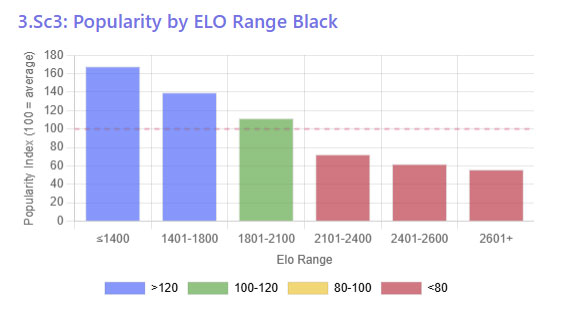
Grandmasters don't like the Scandinavian

After 1.e4 d5 2.exd5 Qxd5 3.Nc3, 3…Qd6 is better than 3…Qa5 in nearly all Elo regions
Furthermore, the opening report shows 3…Qa5 as the most frequently played main system, which is also at the top in all treatises. But the practical chances are higher at every level with 3…Qd6. GMs know this, amateurs apparently don't. The opening report shows that the frequency of 3…Qd6 clearly increases with the Elo rating.
The opening report naturally provides the frequent variations for each main variation. There is a lot of help when deciding what to play: Statistics – of course. But also how popular the system is currently. Then the style of the variation with numerous statements about the positional character, which are known from the style report.
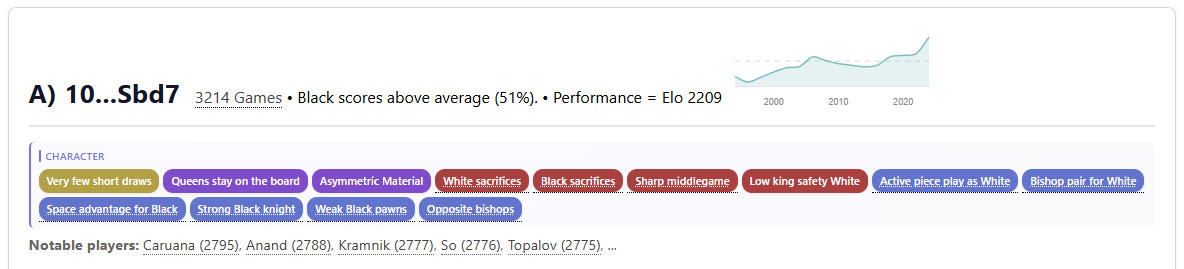
What character does a variation have?
Once you have decided on a move, you play the “instructive” games. These are clear winning games in which a strong player is better or equal against a weaker player after the opening and then shows how to do it right. The report also provides the typical moves of a piece and pawn advances. And finally, the typical tactics. Anyone who has solved all 40 tactical tasks, for example those offered in the Marshall Attack from the Mega Database 2026, has seen the most common motifs. This is practical training!
Plans in the new Reference Search
The new filters catch the eye in the reference search: For example, you can switch off the blitz games with a click. A player filter is also provided, which makes preparation completely easier. With one click you can switch back and forth between a player's repertoire and the overall search.
If you move the mouse over pieces on the board, their typical piece paths and the associated success rate are visualized: The better the results achieved, the greener the move:
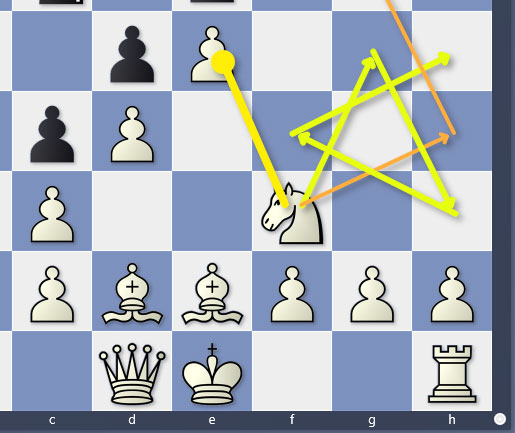
The typical knight manoeuvre against Winawer: Nf3-g5-h3-f4-h6. On the other hand, Nf3-h4xg6 is not very successful
Further innovations
Monte Carlo search shows how difficult a position is to win and provides typical figure paths - Fast and easy duplicate search - Elo profile in style report - Instant analysis of a game runs in parallel on several CPUs - New selectable database symbols - New engine management - Faster remote engine with premium account and much more!
ChessBase '26 - Program Only
- ChessBase 26 Single Program
- 1-year Premium membership
Fritz 20
FRITZ 20 is more than just a chess engine – it is a training revolution for ambitious players and professionals. Whether you are taking your first steps into the world of serious chess training, or already playing at tournament level, FRITZ 20 will help you train more efficiently, intelligently and individually than ever before.
New: playing style simulation at the highest level
FRITZ 20 analyses your next opponent – and plays like them! Use the style analysis in ChessBase 18 to configure whether Fritz should play aggressively, riskily, positionally or or exchange-oriented. This allows you to train specifically for your next game – realistically and practically.
Compete against legends
Compete against the strategies of the greatest players in history: Morphy, Lasker, Capablanca, Tal, Fischer, Karpov – with ELO ratings tailored to you, but in their authentic style. The unique style engine simulates their playing style as convincingly as only FRITZ can. New: the additional playing styles ‘Hypermodern’ and ‘Romantic’.
Play better - even under time pressure
Perfect your reflexes with the new Bullet Training mode: configure the time limit exactly, and learn to keep your nerves under pressure – ideal for blitz and bullet players on online platforms.
AI that understands chess – and speaks
Experience a new dimension of interaction with AI chat and voice output: polished commentary, amusing analyses and subtle hints – spoken in natural language if desired. Fritz commentary at its best. Even stronger.
Even more beautiful. Even more direct.
Highlights in Fritz 20:
- Fritz with 3,580 ELO – world-class level
- Capablanca, Tal, Kasparov Master as virtual opponents
- Opponent simulation via ChessBase 18 Style Report
- Manual opponent configuration
- New playing styles: ‘Romantic’ and ‘Hypermodern’
- Bullet training, AI chat, new 3D graphics, game controller support, new achievements
- 2 month Premium membership